The hand blender is the most underestimated tool in many kitchens. It often arrives as a wedding gift, gets used once for soup, and then lives at the back of a drawer. That is a shame, because a good hand blender can replace several bigger appliances, clean up in seconds and save you real time on the dishes you cook every week.
This guide covers what a hand blender can actually do, the attachments worth having, how to choose one, and the small techniques that make the difference between a smooth result and a splattered wall.
What Makes a Hand Blender Different
A hand blender, also called an immersion or stick blender, brings the blade to the food instead of the other way around. You blend directly in the pot, the bowl or the jug. That simple idea has three big advantages:
- Less washing up. No transferring hot soup into a jug and back again.
- Less space. It fits in a drawer, which matters in compact apartment kitchens.
- More control. You decide exactly how smooth or chunky a dish should be by moving the blender around.
The trade-off is capacity and power for heavy jobs. A hand blender will not knead bread dough or slice a kilo of potatoes into even discs. For those jobs you need a food processor or kitchen machine. For almost everything else on a weeknight, the hand blender is the quickest tool you own.
Ten Things Your Hand Blender Can Do
1. Silky Soups Straight in the Pot
This is the classic use. Lentil soup, a winter favourite in Egyptian homes and a Ramadan staple, goes from cooked lentils and vegetables to a smooth, golden soup in under a minute without leaving the pot. Pumpkin, carrot and vegetable soups work the same way. Take the pot off the heat first, tilt it slightly so the blade stays submerged, and blend in short bursts.
2. Dips and Mezze
Hummus, baba ghanoush and tahini sauce are all easier with a hand blender and its beaker. Use the tall beaker that comes with most models so the ingredients stay together around the blade. For thicker dips like hummus, a chopper attachment gives a better result than the stick alone.
3. Smoothies and Fresh Juices
A banana, a handful of dates, milk and a spoon of honey blended in the beaker make a quick breakfast for children before school. In summer, blend mango or strawberries with ice-cold milk or yoghurt. Add liquid first, then soft fruit, and keep frozen pieces small.
4. Baby Food
Many parents in Egypt buy a hand blender for exactly this. Cooked vegetables, rice and chicken can be pureed to the right texture for each stage. Because you can blend small portions in the beaker, there is little waste.
5. Whipped Cream and Egg Whites
With a whisk attachment, the hand blender becomes a light-duty mixer. Whip cream for desserts, beat egg whites for meringues, or mix pancake and crepe batter without lumps. It is perfect for small quantities where getting out a big stand mixer feels like overkill.
6. Homemade Mayonnaise and Dressings
Put an egg, oil, lemon juice and a pinch of salt into a narrow beaker, place the blender at the bottom and switch on. Slowly lift as the mixture thickens. In about thirty seconds you have fresh mayonnaise. Salad dressings and garlic sauces work the same way.
7. Chopping Onions, Garlic and Herbs
A chopper attachment handles the jobs that make you cry. Onions for mahshi filling, garlic for toumeya, parsley and coriander for salads or green tahini: a few pulses and they are done. Pulse rather than holding the button down, or onions turn to paste.
8. Grinding Nuts and Breadcrumbs
Use the chopper for small batches of nuts for desserts, stale bread for breadcrumbs, or biscuits for a cheesecake base. Work in small quantities and in short pulses so the motor does not strain.
9. Sauces and Gravies
A lumpy bechamel for macarona bechamel can be rescued in seconds. Tomato sauces become smooth and glossy. Blend in the pan, off the heat, with the blade fully submerged.
10. Mashing, Gently
For a smoother mash, use short pulses only. Over-blending potatoes releases starch and turns them gluey, so many cooks prefer a hand masher for potatoes and save the blender for sweet potato or vegetable purees.
Attachments: What Is Worth Having
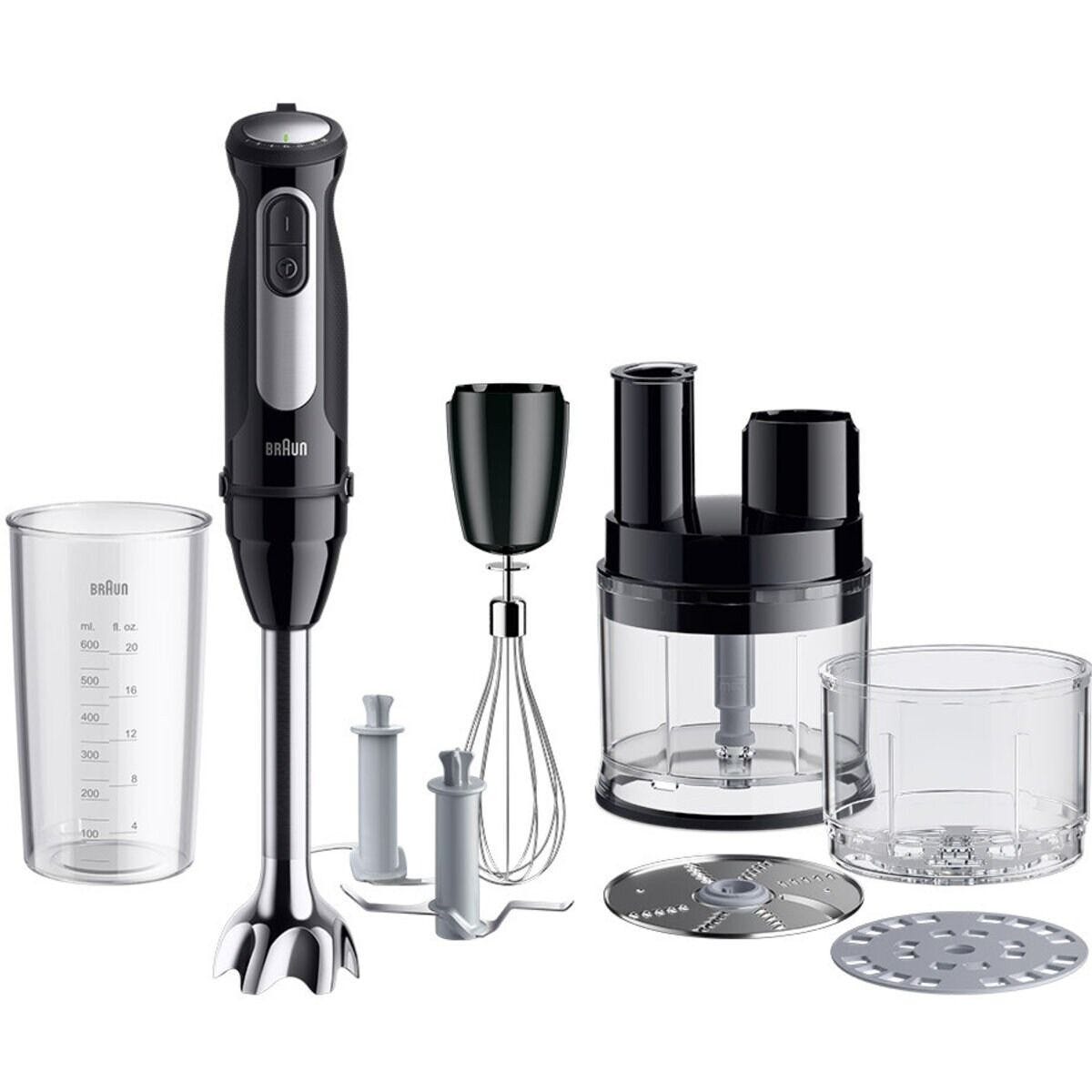
The stick alone covers soups, smoothies and sauces. Attachments decide how far beyond that your blender can go. The product names tell you what each set includes, so read them carefully when comparing.
- Beaker: a tall measuring cup for smoothies, mayonnaise and dips. Almost essential.
- Chopper bowl: for onions, herbs, nuts and garlic. Look at the size: a small chopper suits garlic and herbs, a larger one handles onions for a family meal.
- Whisk: for cream, egg whites and batters.
- Food processor bowl: some sets add a larger bowl that turns the blender into a compact food processor.
For example, the Braun MultiQuick 5 Pro MQ55755M is a 1,000W model with 25 speeds and a four-piece accessory set, while the Braun MultiQuick 5 MQ50236M comes with a 500ml chopper, a whisk and a 600ml beaker. If you want a blender that can also take on bigger chopping jobs, the Braun MultiQuick 7 MQ7085 includes a 1.5L food processor bowl, and the Braun MultiQuick 9 MQ9187XL arrives with eight attachments for cooks who want one tool for almost everything.
How to Choose the Right Hand Blender
Think About What You Cook
If you mainly make soups and smoothies, a simple model with a beaker is enough. The Braun MultiQuick 1 Hand Blender with 600ml Beaker is a straightforward one-speed choice, and its name tells you it is dishwasher safe. If you also chop, whisk and make dips, step up to a set with a chopper and whisk, such as the Braun MultiQuick 3 4-in-1 Set with its 350ml chopper, beaker and whisk.
Power and Speeds
Higher wattage helps with thicker mixtures like hummus or frozen fruit. More speeds give you finer control, useful for whipping cream gently or emulsifying mayonnaise. A one or two-speed model is perfectly fine for soup and baby food.
Comfort and Grip
You hold a hand blender for the whole job, so it should feel balanced in your hand. If possible, check the button placement and weight. A comfortable grip matters more than an extra attachment you will rarely use.
Easy Cleaning
Look for a detachable blending shaft so you can rinse or wash it separately from the motor. The motor body itself should never go under water.
Budget Options
For a simple first blender with a chopper, the DSP 4-in-1 Hand Blender with Chopper is an accessible choice for students, newlyweds setting up their first kitchen, or as a second blender.
Techniques for Better Results
- Submerge before switching on. Start the blender only when the blade is under the surface, and stop it before lifting out. This alone prevents most splashes.
- Use the right container. Tall, narrow containers give better results than wide, shallow bowls.
- Move slowly. Tilt and move the blender gently up and down to pull food into the blade.
- Let hot food rest. Take pots off the heat and let boiling liquids settle for a minute before blending.
- Do not overfill the chopper. Small batches give a more even chop.
- Rest the motor. For long jobs, blend in bursts with short pauses, as the manual suggests.
A Hand Blender Through the Egyptian Year
The beauty of this tool is how it follows the calendar of an Egyptian kitchen.
- Winter: lentil soup, vegetable soups and hot sahlab-style milk desserts, all blended smooth in the pot.
- Ramadan: quick dips and sauces for iftar, fresh juices for suhoor, and whipped cream for konafa and qatayef fillings.
- Eid: batters and creams for cakes and biscuits, in small batches that do not justify a big machine.
- Summer: mango and guava smoothies, chilled yoghurt drinks and cold soups when nobody wants to stand over a hot stove.
Because it is light and stores in a drawer, it is also the appliance most likely to travel with you to the family’s summer flat on the coast.
Safety and Care
A hand blender has an exposed blade, so a few habits matter, especially in homes with children.
- Always unplug before attaching or removing the shaft or attachments.
- Never put your fingers near the blade while the blender is plugged in.
- Keep the motor body away from water; wipe it with a damp cloth.
- Rinse the shaft immediately after use, before food dries on it. Blending warm water with a drop of washing-up liquid in a beaker cleans most of it in seconds.
- Dry attachments fully before storing so they stay fresh.
Common Mistakes to Avoid
- Blending in a shallow pan. The food sprays everywhere.
- Lifting the blade while it runs. Splatter guaranteed.
- Over-blending potatoes. They turn gluey.
- Holding the chopper button down. Pulse instead for an even texture.
- Washing the motor body. Water and motors do not mix.
- Buying more attachments than you will use. Choose based on your real cooking.
Quick Checklist
- I know which dishes I will use it for most: soup, dips, baby food, baking
- I have chosen the attachments that match those dishes
- The blender has a detachable shaft for easy cleaning
- I have a tall beaker for smoothies and mayonnaise
- I know to submerge before switching on and to unplug before cleaning
One Small Tool, Many Meals
A hand blender earns its place by being quick, compact and versatile. It makes the weekly lentil soup, the children’s breakfast smoothie, the Friday tahini and the Eid dessert cream, then rinses clean in seconds and slips back into the drawer. Choose one that fits the way you cook, learn the simple submerge-first technique, and it will become one of the most used tools in your kitchen.
Find hand blenders and kitchen essentials at coccarohome.com.
Shop the Look
- Braun MultiQuick 5 Pro MQ55755M — EGP 7,604 — A 1,000W, 25-speed blender with a four-piece accessory set for varied cooking.
- Braun MultiQuick 5 MQ50236M — EGP 5,615 — Chopper, whisk and beaker included for dips, cream and smoothies.
- Braun MultiQuick 3 4-in-1 Set — EGP 5,030 — A balanced everyday set with chopper, beaker and whisk.
- Braun MultiQuick 7 MQ7085 — EGP 9,944 — Adds a 1.5L food processor bowl for bigger chopping jobs.
- Braun MultiQuick 9 MQ9187XL — EGP 12,870 — Eight attachments for cooks who want one tool for nearly everything.
- Braun MultiQuick 1 with 600ml Beaker — EGP 2,339 — A simple, dishwasher-safe blender for soups and baby food.
- Braun MultiQuick 2 Hand Blender — EGP 2,690 — A light 600W option with a 600ml beaker for daily blending.
- DSP 4-in-1 Hand Blender with Chopper — EGP 1,989 — An accessible starter blender for a first kitchen.
- Heritage Wood Raw Edge Cutting Board — EGP 1,000 — A natural wood board for prepping vegetables before you blend.