Every parent knows the sight: a floor carpeted with building blocks, a doll under the sofa, a puzzle with three pieces missing and a single sock-shaped toy that nobody remembers buying. Ten minutes after tidying, the room looks exactly the same. It is tempting to believe that mess is simply the price of having children.
It does not have to be. A playroom, or a play corner in the living room or bedroom, can stay reasonably tidy with the right system. The secret is not more storage, but the right kind: open, light baskets and bins that children can reach, understand and use on their own. In Egyptian homes, where play often spills into shared family spaces, that system also needs to look good. This guide shows how to build it.
Why Baskets Work Better Than Toy Boxes
The traditional deep toy chest has a problem: everything sinks to the bottom. Children tip the whole thing out to find one car, and the mess begins.
Baskets and smaller bins solve this in several ways:
- One category per basket makes toys easy to find and put away.
- Light weight means children can carry a basket to where they want to play.
- Open tops let toddlers see what is inside without help.
- Natural materials look warm and calm in a living room, unlike bright plastic.
- Flexibility: baskets move between rooms as children’s needs change.
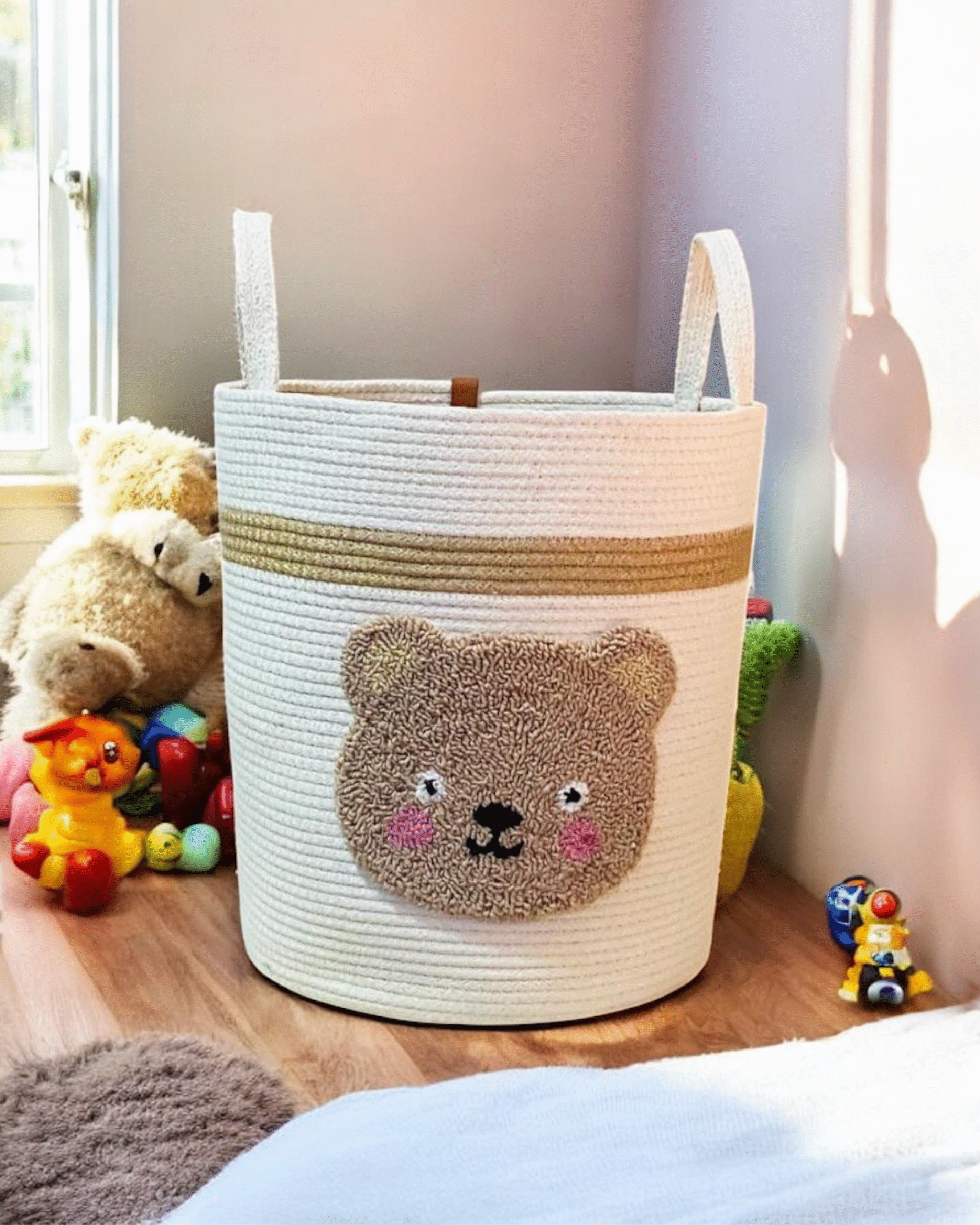
A woven toy basket also doubles as decor. The Teddy Bear Handwoven Jute Toy Storage Basket has an embroidered bear face that children love, and it sits comfortably in a family room without looking like clutter.
Step One: Edit Before You Organize
No storage system can handle too many toys. Before buying baskets, spend an afternoon sorting what you have.
- Gather everything from every room into one place.
- Remove broken toys and puzzles with missing pieces.
- Set aside outgrown toys to donate or pass on to younger cousins.
- Group duplicates and keep only favourites.
- Store sentimental items separately in a memory box.
Involving children works well from around age four. Ask them to choose favourites rather than asking what to give away. You will often find they are happy to let go of far more than you expected. Before Eid and birthdays, when new toys arrive, is a perfect time for this edit.
Step Two: Sort by Category
Once you know what you are keeping, group toys into categories. Common ones include:
- Building blocks and construction sets
- Cars, trains and vehicles
- Dolls and soft toys
- Art supplies
- Puzzles and board games
- Pretend play: kitchens, doctor kits, costumes
- Musical instruments
- Balls and outdoor toys
Each category gets its own basket or bin. Large categories like soft toys need a big basket; small ones like art supplies need small containers.
Matching Basket Size to Toy Type
- Large baskets for soft toys, dress-up clothes and big vehicles.
- Medium baskets for blocks, dolls and pretend play sets.
- Small baskets and pots for crayons, hair clips, figurines and art supplies.
- Lidded bins for items with many small pieces you want to control.
Soft toys pile up quickly in most homes. A large basket such as the Bear on the Ship Jute Toy Storage Basket gives them one cheerful home. For crayons and pencils, a small container like the Handcrafted Crochet Cotton Pot and Organizer Basket keeps them together on a table or shelf.
Step Three: Labels Children Understand
Labels turn a pile of baskets into a system. For young children who cannot read yet, use picture labels.
- Take a photo of the toys in each basket, print it and attach it to the front.
- Use simple drawings or icons for each category.
- Add the word in Arabic and English, so labels double as early reading practice.
- Place labels at a child’s eye level.
When a child can see that cars go in the basket with the car picture, tidying becomes a matching game rather than a chore.
Step Four: Store at Child Height
If children cannot reach the storage, they cannot tidy it. Keep everyday toys low.
- Bottom shelves and floor level for toys used daily.
- Middle shelves for toys that need some supervision, like puzzles.
- High shelves for messy items like paint, playdough and anything with tiny pieces for younger siblings.
A low open shelf unit with baskets on each shelf is the classic playroom solution. If you do not have shelves, baskets lined up along a wall work just as well.
Lidded baskets are useful for categories you want to rotate or keep out of sight. The Bear-Shaped Woven Cotton Rope Storage Basket with Lid keeps contents hidden while adding a playful shape to the room.
Step Five: Rotate Toys
Toy rotation is one of the most effective tricks for a calmer playroom. Instead of having every toy out at once, keep about a third out and store the rest.
How to rotate:
- Divide toys into three or four groups, each with a mix of categories.
- Keep one group out; store the others in lidded baskets or a cupboard.
- Every two to three weeks, swap the groups.
Children play more deeply with fewer toys, and “old” toys feel new again when they reappear. Rotation also reduces the volume of mess that needs tidying each evening.
Creating Play Zones
Even in a small apartment, defining areas for different kinds of play keeps things organized.
The Floor Play Zone
A soft rug defines where play happens and makes floor play comfortable on cold tiles. The Handcrafted Crochet Bear-Shaped Kids Play and Nap Rug is soft cotton and gives toddlers a cosy, clearly marked spot for play and naps.
The Reading Corner
A floor cushion, a small basket of books and good light create a quiet spot. Keep only five to eight books out at a time and rotate them along with toys.
The Creative Table
A small table with art supplies in labelled containers encourages drawing and crafts. Keep paper in a tray and crayons in small pots so everything returns to the table after use.
Using Walls and Doors
When floor space is limited, go up. A hanging organizer on a wall or the back of a door holds small soft toys, hair accessories or art supplies. The 3-Tier Wall Hanging Basket in Woven Cotton Rope is ideal for this, keeping small items visible and off the floor. For safety, fix wall storage securely and keep it light enough that nothing heavy can fall on a child.
Making Tidying a Habit
The best system still needs a routine.
- Tidy before transitions: before meals, bath time and bed.
- Use a song or timer: five minutes of tidying feels like a game.
- One basket at a time: finish one category before starting another.
- Model it: children copy what they see adults do.
- Praise effort, not perfection.
Play Corners in Shared Family Spaces
In many Egyptian apartments, there is no separate playroom. Toys live in the living room, where guests are received and the family gathers in the evening. Baskets make this work. Choose two or three attractive woven baskets that suit your living room decor and line them along a wall or under a console. During the day, they hold toys within reach; in the evening, everything goes back in and the room becomes an adult space again within minutes.
A coordinated set helps the baskets look intentional rather than scattered. The Bear on the Ship Nautical Nursery Storage Set gives several matching pieces for sorting toys by type, so even a play corner in the living room looks planned.
Storage That Grows With Your Children
Toddlers need large, open baskets they can tip and fill easily. As children grow, their toys get smaller and more numerous: building sets with hundreds of pieces, craft kits, collectible figures. Adapt the system as they grow.
- Under three: a few large open baskets, all at floor level, with picture labels.
- Three to six: more categories, smaller baskets for art supplies, and the start of toy rotation.
- Six and up: lidded bins for sets with small pieces, a desk area for crafts and homework, and more responsibility for their own tidying.
Natural woven baskets have an advantage here: when they are no longer needed for toys, they move on to hold blankets, magazines or laundry elsewhere in the home.
Common Mistakes to Avoid
- Buying storage before editing. You end up organizing toys you do not need.
- One giant toy box. Everything sinks to the bottom and gets tipped out.
- Storage out of reach. Children cannot tidy what they cannot reach.
- No labels. Without them, toys go into whatever basket is nearest.
- Every toy out at once. Overwhelm leads to more mess and less play.
- Unsecured furniture. Shelves and wall units must be fixed firmly to the wall.
Quick Checklist
- Toys edited and broken items removed
- Toys sorted into clear categories
- One basket or bin per category, sized to fit
- Picture labels at child height
- Everyday toys stored low and within reach
- A rotation system with stored groups
- Defined zones for floor play, reading and art
- Wall storage fixed securely
- A short tidying routine before meals and bed
A Playroom That Stays Playful
An organized playroom is not about perfect shelves; it is about giving children a system simple enough that they can manage it themselves. With the right baskets, clear categories and a regular routine, play becomes calmer and tidying becomes part of the game.
Browse handwoven toy baskets, kids’ storage sets and soft play rugs at coccarohome.com and create a playroom the whole family enjoys.
Shop the Look
- Teddy Bear Jute Toy Storage Basket — EGP 2,160 — A friendly bear basket that looks good in family rooms.
- Bear on the Ship Jute Toy Basket — EGP 1,890 — One cheerful home for a pile of soft toys.
- Pink Ribbon Rope Toy Storage Basket — EGP 1,890 — A sweet basket for dolls and dress-up clothes.
- Hello Kitty Jute Toy Storage Basket — EGP 1,890 — A playful basket children will want to use.
- Bear-Shaped Rope Storage Basket with Lid — EGP 2,700 — Lidded storage for toys in rotation.
- Bear on the Ship Nursery Storage Set — EGP 2,790 — A coordinated set for sorting by category.
- Crochet Cotton Pot and Organizer — EGP 200 — Keeps crayons and pencils together.
- Crochet Bear-Shaped Play and Nap Rug — EGP 4,800 — A soft, defined floor play zone.
- 3-Tier Woven Rope Wall Hanging Basket — EGP 1,200 — Gets small toys off the floor.
- Bohemian Fabric Collapsible Storage Cube — EGP 303 — Light, foldable bins for shelves.